
- About Us

- Our Services
- Your Industry
- Resources
- News & Blog
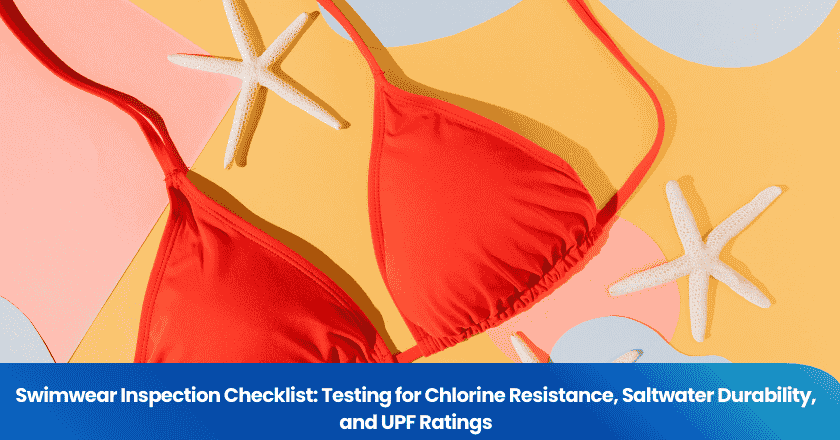
The manufacturing of professional-grade swimwear is governed by technical complexities that far exceed those of standard apparel. Due to constant exposure to high-concentration halogens (chlorine), electrolytic saltwater, and intense solar radiation, the structural integrity of swimwear must be validated through rigorous Softline Quality Assurance (QA) protocols. A failure in material selection or chemical stabilization can lead to 'Spandex snapping,' color shade shifts, and the loss of critical UV protection. For manufacturers and importers, adhering to international testing benchmarks like ISO 105 and AATCC 162 is essential to ensure that garments maintain their designed silhouette and protective functions in harsh aquatic environments.

Key Takeaways
- Oxidative chemical resilience is critical for preventing the degradation of elastomeric fibers in chlorinated pool water.
- UPF ratings (Ultraviolet Protection Factor) must be measured using spectrophotometry to confirm skin safety against UVA and UVB rays.
- Saltwater durability protocols assess the electrolytic stability of dyes and the corrosion resistance of metal fasteners.
- Material composition, specifically the use of PBT (Polybutylene Terephthalate), offers up to 20 times more chlorine resistance than traditional Spandex.
- Professional apparel quality control must include testing in both wet and stretched states to simulate real-world use.
- Compliance with GRS and OEKO-TEX standards ensures the chemical safety of garments in direct contact with skin.
The Chemistry of Polymer Degradation in Aquatic Environments
Standard swimwear relies on Elastane (Spandex/Lycra) for its exceptional modulus of elasticity. However, Spandex is a polyether-based polyurethane that is highly susceptible to oxidative attack by chlorine. When exposed to chlorinated water, the halogen ions penetrate the fiber and break the urea-urethane bonds, leading to a permanent loss of 'recovery force.' This technical failure results in the garment becoming sagging and transparent—a phenomenon known as 'Spandex Snap.'
PBT vs. Elastane: A Molecular Comparison
To mitigate this, high-performance lines utilize PBT (Polybutylene Terephthalate) or specialized Chlorine-Resistant Elastane. PBT is a textured polyester with a helical molecular structure that provides stretch through mechanical geometry rather than chemical elasticity. Because it lacks the vulnerable polyether segments, it remains stable in environments with 20-50 ppm of active chlorine, whereas standard Spandex begins to degrade at levels as low as 5 ppm.
| Property | Standard Spandex/Nylon | PBT/Polyester Blend |
|---|---|---|
| Molecular Vulnerability | High (Polyether bond) | Low (Helical Polyester) |
| Chlorine Longevity | 50 - 80 Hours | 300+ Hours |
| Hydrophobicity | Moderate (Absorbs water) | High (Quick-dry) |
| UV Stability | Breaks down under UVA | Inherently UV Resistant |
Quantitative Chlorine Resistance Testing: AATCC TM162
The AATCC TM162 standard is the definitive protocol for evaluating colorfastness to water in swimming pools. Unlike a simple soak test, this method involves immersing fabric specimens in a solution containing 5 ppm of active chlorine, maintained at a pH of 7.0 and a temperature of 27'C. The mechanical agitation simulates the friction of a swimmer moving through water.
Colorfastness and Shade Shift Analysis
After the exposure cycle, technicians use a Gray Scale for Color Change (ISO 105-A02) to evaluate the results. A passing grade for professional swimwear is typically Grade 4.0 or higher. A significant shade shift (lower than Grade 3.0) indicates that the dyes used are not 'active-chlorine stable,' which would result in rapid fading after just a few sessions in a commercial pool.
Technical Standard Note: Many low-cost manufacturers use fluorescent brighteners to achieve vibrant neon colors. These chemicals are highly unstable under UV radiation and chlorine, often dropping from a Grade 5.0 to a Grade 1.0 within 24 hours of exposure. Regular quality assurance audits are required to verify dye stability.
UPF Physics: The Engineering of Sun Protection
UPF (Ultraviolet Protection Factor) is a technical rating for fabrics, distinct from SPF used for sunscreens. While SPF only measures UVB protection, UPF covers the entire ultraviolet spectrum. The effectiveness of a fabric's UPF rating is a function of fiber density, weave tightness, and the presence of UV-absorbing additives like Titanium Dioxide (TiO2).
UV Standard 801 vs. ASTM D6603
While standard UPF testing (ASTM D6603) measures the fabric in a dry, new, and relaxed state, the **UV Standard 801** is far more rigorous. It requires the fabric to be tested under 'Extreme Conditions':
- Wet State: Water filling the gaps between fibers can increase UV transmission.
- Stretched State: Stretching a garment on the body thins the fabric, reducing protection.
- Aged State: Testing after the fabric has undergone multiple wash cycles and abrasion.
A garment that claims 'UPF 50+' under Standard 801 provides a much higher technical assurance of safety for the end-user than one tested under standard dry protocols.
Saltwater Durability and Electrolytic Stability
Ocean environments introduce the challenge of Sodium Chloride (NaCl) at concentrations of 35,000 ppm. Saltwater acts as an electrolyte, accelerating the galvanic corrosion of metal trims (zippers, buckles) and potentially triggering 'dye migration' (bleeding) between high-contrast panels, such as white and navy blue.
ISO 105-E02: Artificial Seawater Test
Laboratory validation involves soaking specimens in artificial seawater (ISO 105-E02) and placing them in a perspirometer under high pressure for 4 hours at 37'C. This simulates a wet swimsuit being left in a beach bag. Failure is identified through 'staining' on adjacent multi-fiber witness cloths. High-quality product inspections should always mandate this test for multi-color designs to prevent post-purchase consumer complaints.
| Test Type | Standard Reference | Technical Objective |
|---|---|---|
| Chlorine Resistance | ISO 105-E03 | Assess shade shift in halogenated water |
| Seawater fastness | AATCC 106 | Verify dye stability against high salinity |
| UV Aging | ISO 105-B02 | Predict solar-induced fiber degradation |
| Abrasion (Pilling) | ASTM D4966 | Test resilience against rough pool edges |
Manufacturing Quality Control and Workmanship
Effective manufacturing quality control requires oversight at every stage of an order—from pre-production planning and in-process monitoring to pre-shipment inspection—to ensure consistent workmanship and product compliance. As a third-party inspection service provider, TradeAider provides Inspection & QA Services across the entire production sourcing process to help ensure goods meet defined quality standards. TradeAider assigns experienced inspectors to conduct on-site products inspection in accordance with international inspection protocols and customer-specific requirements, including sampling methods, defect classification, and finished-product assessment. This structured approach reduces the risk of quality fade during mass production.
TradeAider Sampling Plan: ANSI/ASQ Z1.4-2008
Inspections can be performed as either random sampling or 100% full inspection. At TradeAider, we use the globally trusted ANSI/ASQ Z1.4-2008 (AQL) Single Sampling Plan for all inspections. This standard, aligned with ISO 2859-1 and equivalents such as BS6001 and DIN 40080, ensures consistent, reliable quality checks. For a 500-piece order, a General Inspection Level II (G-II) might involve checking 50 units; sampling quantities can also be customized according to client requirements.
AQL Defect Classification:
- Critical: Safety risks (e.g. needles in fill), tolerance 0.
- Major: Functional issues (e.g. failed fill power, significant down leakage). Tolerance 1.5.
- Minor: Aesthetic issues (e.g. slight shading, uncut threads). Tolerance 4.0.
Key On-Site Inspections and Data Measurement
TradeAider inspectors perform a comprehensive suite of tests determined by the characteristics of each product. Beyond basic visual appearance checks, on-site inspections also cover quantitative measurements, functional performance, and material verification, including:
- Quantity and Packaging: Verification of product counts, carton dimensions, and shipping marks.
- Workmanship: Inspecting visual defects such as scratches, dents, or dirty marks on the shell fabric.
- Data Measurement: Inspecting by performing carton drop tests, barcode scan tests, and rubbing tests for safety labels.
- Functional Tests: Power measurement for heated down jackets, durability tests for zippers, and actual use tests for hood adjustments.
- Internal Checks: verifying fill species (Goose vs. Duck) and ensuring no "heavy" feathers or contaminants are present.
Technical Workmanship and Structural Integrity Checks
Due to the high-stretch and close-fit nature of swimwear, mechanical construction quality is critical to product performance and wearer comfort. Swimwear typically requires specialized flatlock or overlock stitching to allow seams to elongate without breaking. During quality inspections, inspectors verify Stitches Per Inch (SPI)—generally 10–12 for high-stretch seams—to ensure optimal seam elasticity. An SPI that is too low may cause seam gaping, while an excessively high SPI can damage delicate elastomeric fibers.
Key checkpoints for technical workmanship include:
- Hygienic Liner Integrity: Ensuring the adhesive does not leave a residue on the delicate lining fabric.
- Dimensional Stability: Verifying that the garment does not shrink or 'grow' by more than 3% after industrial laundering (ISO 6330).
- Hardware Corrosion: Using Grade 316 Stainless Steel or plastic-coated trims to prevent rust spots.
- Symmetry and Fit: Utilizing 3D fit mannequins to ensure the tension is distributed evenly across the bust and hips.
Real-Time Documentation and Reporting Systems
Data transparency is the cornerstone of effective quality assurance. TradeAider inspectors document findings with photos, videos, and precise measurements, leading to a conform, non-conform, or pending verdict. All results are uploaded in real time to the TradeAider Service System.
Clients can access an Online Real-time Report while the inspection is still in progress. This allows for immediate decision-making—pending or non-conforming items are communicated instantly, enabling the client to decide whether products are acceptable or need on-site rectification by the supplier. An Official Report detailing the final situation is provided within 24 hours as standard practice.
User Care Protocols for Extending Garment Life
Technical performance is also dependent on post-purchase care. Professional aquatic apparel should follow these technical maintenance guidelines:
- Immediate Neutralization: Rinsing in fresh water immediately after exit from a pool neutralizes active chlorine before it can oxidize the Spandex fibers.
- Avoid Thermal Stress: Tumble drying at high heat is the primary cause of 'Elasticity Death.' Air-drying in the shade is mandatory to maintain fiber modulus.
- Detergent Selection: Using mild, pH-neutral detergents prevents the stripping of UV-protective coatings and hydrophobic finishes.
Ready to secure your product quality before shipment?
As your third-party inspection, testing & certification partner in China, TradeAider supports brands and sourcing teams across the entire production process, helping you identify quality risks early, ensure compliance, and strengthen your team’s capabilities before shipment.
Book an Inspection or Testing Service with TradeAider today, or for tailored solutions and expert guidance, contact us at services@tradeaider.com or submit the request form on the right. →
Frequently Asked Questions
What is the difference between UPF and SPF?
SPF (Sun Protection Factor) measures the time it takes for skin to burn under UVB rays and is used for topically applied sunscreens. UPF (Ultraviolet Protection Factor) measures the actual amount of UV radiation (both UVA and UVB) that penetrates a fabric. A UPF 50 fabric blocks 98% of all UV rays.
Why did my swimsuit turn yellow?
Yellowing is typically a sign of Spandex oxidation caused by excessive chlorine or exposure to high-heat dryers. It can also be caused by the reaction of 'phenolic antioxidants' in the fabric with nitrogen oxides in the air during warehouse storage.
Can I wash my swimsuit in a washing machine?
Technically, yes, but only on a 'Delicate' cycle with cold water. The mechanical agitation of a standard cycle can snag the fine knit of the fabric and weaken the seams. Hand-washing remains the gold standard for maintaining swimwear longevity.
Does a wet swimsuit provide less UV protection?
For most fabrics, yes. Water fills the microscopic gaps between fibers, reducing the 'scattering' of UV light and allowing more radiation to reach the skin. This is why fabrics tested under the **UV Standard 801** (which includes wet testing) are superior for safety.
How can I identify high-quality swimwear fabric?
Look for 'PBT' or 'Xtra Life Lycra' on the fiber composition label. Perform a 'Recovery Test': stretch the fabric to its limit and release; it should snap back instantly to its original dimensions without any audible 'cracking' of the internal fibers.

Related Articles
Grow your business with TradeAider Service
Click the button below to directly enter the TradeAider Service System. The simple steps from booking and payment to receiving reports are easy to operate.