
- About Us

- Our Services
- Your Industry
- Resources
- News & Blog
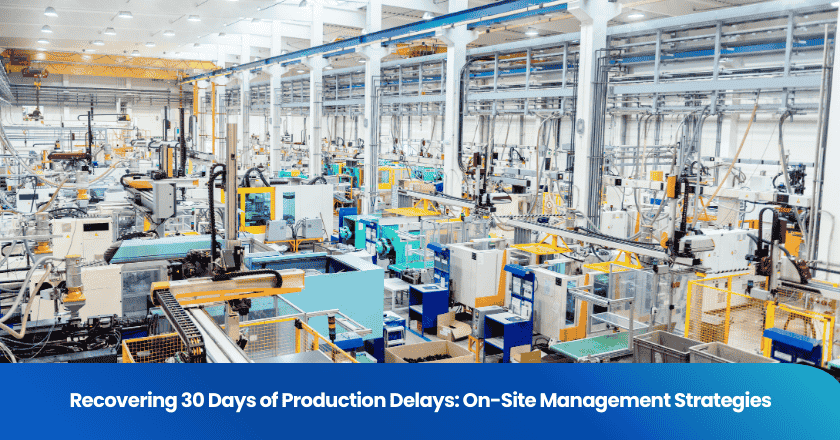
Recovering a significant loss of production time—such as a 30-day delay—requires more than just overtime; it demands targeted on-site management. By shifting focus from passive monitoring to active problem-solving, teams can prevent minor issues from compounding into major setbacks. Leveraging real-time data intervention and agile strategies allows decision-makers to act on facts rather than guesswork, ensuring a rapid return to the planned schedule.

| Mechanism | Impact on Production Delays |
|---|---|
| Real-time inventory tracking | Reduces guesswork and supports just-in-time practices. |
| Automated downtime logging | Helps identify chronic issues and prioritize preventive maintenance. |
| Predictive maintenance | Reduces unplanned downtime by addressing equipment issues proactively. |
| Real-time quality monitoring | Allows for early intervention, reducing rework and scrap. |
| Rapid response to production issues | Maintains flow and prevents bottlenecks. |
Key Takeaways
- Real-time Data Utilization: Implementing tools to track production metrics and monitor equipment performance allows teams to spot delays instantly.
- Crisis Team Deployment: Assembling a dedicated on-site team with clear roles ensures fast, decisive problem-solving.
- Strategic Prioritization: focusing on bottlenecks and high-impact tasks allocates resources where they are needed most.
- Proactive Quality Control: Catching defects during production prevents the compounding effect of rework, which often causes further delays.
- Transparent Communication: Regular, data-backed updates build trust with stakeholders and keep everyone aligned on recovery goals.
Assessing the Delay On-Site
Identifying Root Causes
Upon arrival, on-site teams must immediately conduct a root cause analysis. Common culprits include equipment breakdowns, inefficient workflows, and supplier bottlenecks. Often, disjointed supply chains—where design, sourcing, and manufacturing operate in silos—exacerbate these delays. Identifying whether the issue stems from inflexible processes, stockouts, or high minimum order requirements is the first step toward recovery.
- Equipment breakdown and maintenance failures
- Redundant or unnecessary processes
- Supplier delivery interruptions
- Unplanned design changes
- Inefficiencies in the supply chain
- Coordination issues with multiple manufacturers
Tip: Teams should focus on the most frequent sources of delay first using the Pareto Principle (80/20 rule) to achieve the fastest results.
Quantifying Delay Impact
Quantifying the financial and operational impact of a delay is crucial for prioritizing resources. Metrics like Delay Cost Impact (DCI) translate lost time into monetary terms, accounting for resource drain, lost opportunities, and customer dissatisfaction. Understanding the Cost of Delay (CoD) per day helps leadership allocate budgets effectively for recovery efforts.
| Metric | Description |
|---|---|
| Delay Cost Impact (DCI) | Translates delay measurements into monetary terms, considering resource costs, opportunity costs, and customer impact. |
| Cost of Delay (CoD) | Calculates the economic impact of time lost, helping teams prioritize features or fixes based on value. |
Real-Time Data Collection
On-site teams leverage digital tools to track production volume, downtime, and Overall Equipment Effectiveness (OEE). Measuring throughput rates and capacity utilization reveals whether the factory is maximizing its potential. Real-time alerts from digital signage software ensure that managers can spot deviations instantly and act before they spiral.
Immediate Actions for Recovering Schedule
Recovering a month of lost time requires immediate, decisive action to stabilize the project trajectory. On-site management transforms passive oversight into active intervention, ensuring every minute is optimized for recovery.
Crisis Team Assembly
When a project falls significantly behind, a cross-functional crisis team must be deployed. This team includes experts in logistics, quality, and engineering who meet daily on-site to review progress. Their primary goal is to make rapid decisions that clear obstacles without sacrificing product quality.
- Daily review of the production progress schedule.
- Task assignment based on problem-solving capability.
- Real-time updates to keep all departments synchronized.
Stakeholder Communication
Clear, transparent communication prevents panic and misalignment. Stakeholders—including clients and suppliers—need regular, simplified updates regarding the recovery plan. Timely updates build confidence and demonstrate control over the situation.
Task Prioritization
Teams must identify and tackle the critical path activities that offer the highest time recovery. Distributing decision-making authority helps eliminate bottlenecks, while focusing quality assurance on high-risk areas prevents late-stage defects.
| Evidence Description | Impact |
|---|---|
| Productivity bottlenecks | Can cost enterprises millions annually in lost efficiency. |
| Addressing key bottlenecks | Teams have cut wasted time by 65% post-intervention. |
| Cost of downtime | An hour of downtime can cost enterprises between $500K to $1M. |
On-Site Process Optimization
Streamlining Workflows
On-site teams recognize that in critical recovery phases, every minute is pivotal. Their primary objective becomes the identification and elimination of non-value-added steps to accelerate the production timeline. Proven methodologies like Lean Manufacturing and Six Sigma are often deployed to streamline these workflows.
| Methodology | Expected Outcomes | Key Advantages |
|---|---|---|
| Six Sigma | Near-zero defects, cost savings | Data-driven, strong ROI |
| Lean Manufacturing | Less waste, faster production | Speed, employee engagement |
| Root Cause Analysis | Prevents repeat problems | Develops analytic skills |
Resource Reallocation
Agile resource management is essential during a crisis. Teams assess current allocations and shift manpower or equipment to delayed tasks immediately. Whether adding shifts or hiring subcontractors, the focus remains on catching up while maintaining quality standards.
Bottleneck Elimination
Bottlenecks are the primary enemy of speed. Teams use value stream mapping to visualize delays and implement changes such as workflow redesigns or automation. Proactive maintenance ensures machinery uptime, preventing new bottlenecks from forming.
Real-Time Quality Control to Prevent Delays
Real-time quality control serves as the backbone of any successful recovery plan. By inspecting products during production rather than after, teams prevent the compounding effect of defects that leads to massive delays.
During Production Inspection (DPI)
DPI inspections occur while goods are on the assembly line. Inspectors verify surface quality, assembly integrity, and functionality immediately. This allows for instant corrective actions, reducing the overall defect rate and preventing final inspection failures.
Online Real-Time Reporting
Digital dashboards provide stakeholders with instant visibility into factory floor operations. Anomaly detection algorithms alert managers to deviations in real time, allowing for immediate course correction. This level of transparency ensures that small issues are resolved before they impact the delivery date.
| Benefit | Description |
|---|---|
| Immediate anomaly detection | Real-time dashboards provide visibility to act on anomalies before they escalate. |
| Enhanced operational efficiency | Monitoring equipment performance reduces downtime and boosts throughput. |
| Competitive advantage | Instant reaction to trends allows for confident, data-driven decision-making. |
Immediate Problem Solving
When a delay or defect is identified, on-site teams prioritize immediate problem solving. By minimizing human error through automated detection and fostering clear communication, teams can maintain momentum and recover lost time efficiently.
Continuous Control for Long Delays
Total Quality Control (TQC) Strategies
For large projects facing significant delays, implementing a Total Quality Control (TQC) framework provides a robust solution. Placing experts on-site for the duration of the contract ensures that every process step adheres to standards, preventing delay damages and minimizing the risk of contract disputes.
Transparency and Monitoring
Utilizing real-time data processing ensures end-to-end visibility. Live status updates keep all parties informed, reducing the likelihood of surprises and supporting fair contract claims if necessary.
Supervised Rework to Minimize Delay
Pre-Shipment Inspection (PSI)
Pre-shipment inspection acts as the final gatekeeper. By identifying defects before goods leave the factory, teams prevent the logistical nightmare of returns. Early detection systems are critical, as a significant percentage of product recalls stem from poor process design or late detection.
On-Site Repair and Replacement
Finding defects is only half the battle; fixing them immediately is key. On-site inspectors oversee repairs and replacements directly at the factory, ensuring that shipments are corrected without the need for time-consuming returns.
Agile Strategies for Delay Recovery
Agile methodologies allow construction and manufacturing teams to adapt quickly. Strategies like predictive maintenance prevent equipment failure, while master scheduling with buffers provides the flexibility needed to absorb unexpected setbacks.
Supply Chain Optimization
Optimizing the supply chain reduces lead times and enhances resilience. By balancing inventory and speeding up delivery, teams can recover from disruptions more effectively.
| Aspect | Impact on Production Delay Recovery |
|---|---|
| Faster Delivery | Reduces lead times, keeping operations smooth. |
| Risk Mitigation | Enhances resilience against disruptions for quicker recovery. |
| Inventory Management | Balances supply and demand to prevent shortages. |
Leadership and Team Collaboration
Strong on-site leadership fosters a culture of problem-solving. Leaders who are present on the floor can make real-time decisions based on actual data, inspiring the team to stay focused and motivated during the recovery push.
Monitoring Progress and Adjusting
Tracking recovery requires focusing on key milestones. Teams must assess schedule health, filter for critical steps, and adapt plans on-site. Whether re-sequencing activities or reallocating resources, flexibility is essential for turning a delayed project into a success story.
Practical Illustration: Delay Recovery in Action

Early Defect Detection Example
Consider a production line assembling electronics. During a routine During Production Inspection (DPI), inspectors identify a casing defect affecting 50% of the batch. Immediate detection prevents this issue from contaminating the entire order.
Immediate Intervention Outcome
The team pauses production, identifies the root cause with factory staff, and implements a fix immediately. Real-time reporting keeps the client informed. The result? The order ships on time, avoiding a potential 30-day delay for rework. On-site management proves that proactive intervention is the ultimate tool for schedule recovery.
FAQ
What is the fastest way to spot production delays on-site?
Teams use real-time data tools and daily inspections to check equipment, track output, and monitor for slowdowns. This allows for quick detection and action.
How does on-site management help recover lost time?
On-site managers make immediate decisions, guide teams, fix problems, and adjust schedules in real time, keeping everyone focused on recovery.
Can real-time reporting prevent future delays?
Yes. Real-time reporting highlights problems as they occur, allowing teams to respond quickly and implement better systems to prevent recurrence.
What should teams do when they find defects during production?
Teams should stop the line, review the defect, and fix the process immediately using DPI protocols. Fast action prevents further defects and saves significant time.
Related Articles


Grow your business with TradeAider Service
Click the button below to directly enter the TradeAider Service System. The simple steps from booking and payment to receiving reports are easy to operate.
