
- About Us

- Our Services
- Your Industry
- Resources
- News & Blog
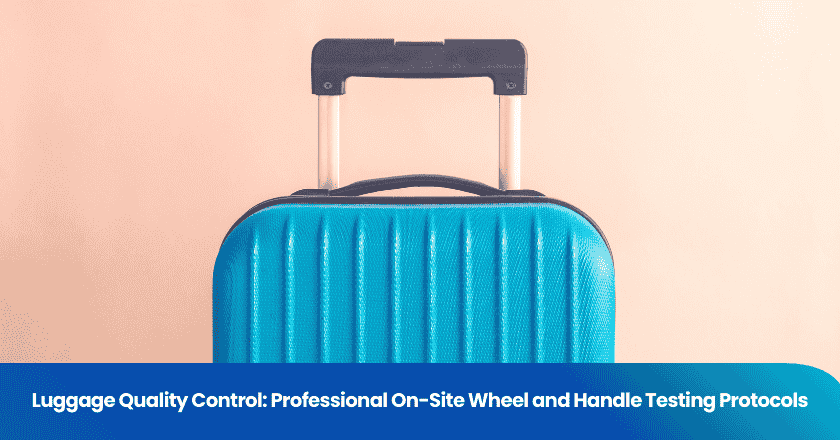
In the global travel goods industry, luggage inspection is the definitive process that separates high-performance travel gear from unreliable substitutes. Professional on-site quality control focuses heavily on the two most common failure points: the wheel system and the telescoping handle. For aluminum-frame luggage, which is often marketed as a premium, long-term investment, these systematic quality checks ensure that the product can withstand the mechanical rigors of airport baggage handling systems and diverse urban terrains. By identifying defects such as bearing drag or handle misalignment before shipment, brands protect their reputation and minimize costly international returns.
Key Takeaways
- Wheel Durability: Endurance testing over 12km to 32km is standard for validating wheel bearing longevity.
- Handle Precision: Telescoping handles must pass at least 5,000 extension-retraction cycles without mechanical jamming.
- Material Standards: Quality control verifies aluminum alloy grades (usually 6061 or 6063) to ensure optimal strength-to-weight ratios.
- Real-Time Data: Digital reporting allows for immediate rejection of batches failing the 'Jerk Test' or 'Drop Test.'
- AQL Compliance: Defect classification ensures that critical structural issues result in immediate production halts.
The Critical Importance of Wheel Performance Testing
The travel experience is largely dictated by 'rollability.' Luggage wheels must navigate everything from smooth airport marble to abrasive asphalt and cobblestone. In a standardized quality assurance program, wheel testing goes beyond a simple spin. It involves analyzing the interaction between the wheel tread, the ball bearings, and the axle housing.
Visual and Assembly Integrity Audits
Before mechanical testing begins, an inspector performs a static assembly audit. This includes checking for "Injection Flash" on plastic wheels, which can cause rhythmic thumping and premature wear. The mounting screws of the caster housing must be torque-tested to ensure they won't vibrate loose under the high-frequency tremors experienced during transport.
| Inspection Point | Visual/Manual Check | Acceptance Standard |
|---|---|---|
| Wheel Concentricity | Rotate wheel at high speed manually. | Zero visible wobbling or eccentricity. |
| Bearing Clearance | Lateral movement check on the axle. | Maximum 0.5mm play allowed. |
| Housing Fit | Check gap between wheel and caster shell. | Uniform gap to prevent pebble wedging. |
| Material Finish | Check for cracks or molding bubbles. | Surface must be smooth and defect-free. |
Advanced Mechanical Wheel Endurance Tests
To simulate years of use, quality teams utilize the QB/T 2155 industrial standard, which defines the walking test for rolling luggage. The luggage is loaded to its rated capacity (typically 15kg to 35kg) and placed on a treadmill equipped with 'bump bars.'
Walking and Abrasion Parameters
- Endurance Distance: Standard luggage must roll for 12km, while premium aluminum luggage often requires 32km.
- Obstacle Impact: The treadmill includes 5mm high bumps to test the shock absorption of the wheel suspension.
- Speed Regulation: Testing is conducted at a constant 4km/h to simulate a brisk walking pace.
- Temperature Exposure: Wheels are tested in both high and low-temperature chambers to ensure the polymer doesn't become brittle or excessively soft.
"The difference between a luxury suitcase and a generic one lies in the bearing quality. A premium wheel should continue to spin for at least 5 seconds after a single manual flick."
Handle Telescoping Functionality and Fatigue
The telescoping handle is the primary interface between the user and the luggage. It must be rigid enough to steer a heavy load yet flexible enough to retract instantly into the aluminum frame. Quality control for handles focuses on the 'Locking Pin' mechanism and the 'Tube Tolerance.'
Extension, Retraction, and Locking Audits
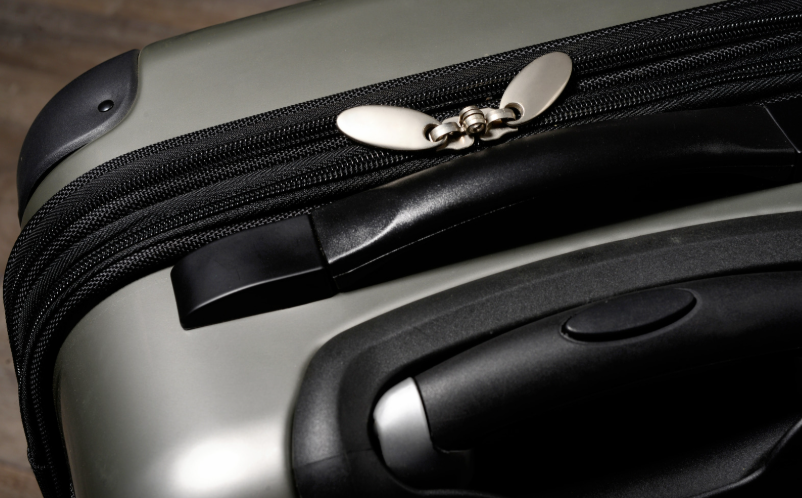
Inspectors perform a "Smoothness of Action" test, where the handle is extended to its maximum height and then collapsed. Any "grittiness" suggests metal shavings inside the tubes or poor lubrication. The locking mechanism is then tested at each height stage to ensure it doesn't collapse under a 50kg downward force.
| Test Type | Procedure | Technical Benchmark |
|---|---|---|
| Fatigue Cycle Test | Automated extension and retraction. | 5,000 cycles without component failure. |
| Bending Resistance | Apply lateral force while extended. | Deflection must not exceed 10mm. |
| Oscillation Test | Vibrate loaded bag by the handle. | No cracking at the handle-to-frame joint. |
| Salt Spray Test | 24-hour exposure to saline mist. | Zero oxidation or rust on metal parts. |
Material Verification for Premium Aluminum Luggage
Aluminum luggage is prized for its "Series 6" aluminum alloys. Inspectors verify that the telescoping tubes are made of reinforced aluminum rather than thinner, cheaper substitutes. This is confirmed through weight-per-meter checks and, in some cases, handheld X-ray fluorescence (XRF) analyzers to determine elemental composition.
- Anodization Quality: The surface finish must be uniform to prevent scratches and chemical corrosion.
- Rivet Integrity: Since aluminum cases are riveted, each rivet must be checked for 'head deformation' and tightness.
AQL Defect Classification and Reporting
In a professional quality control inspection, findings are categorized based on their impact on the consumer experience. Digital tools allow inspectors to upload 4K video of a failing handle or wheel directly to the cloud, enabling the client to see the defect in real-time.
- Critical Defects: Sharp metal edges on the aluminum frame or broken rivets. Acceptance = 0.
- Major Defects: Handle jamming, wheel seizing, or zippers that split under pressure. These impact the core function.
- Minor Defects: Slight color variation in the anodization or small surface scratches.
Best Practices for Importers and Brands
To maintain a low defect rate, brands should request a Final Random Inspection (FRI) when 100% of the goods are finished and 80% are packed. This ensures that the packaging—including the silica gel desiccant packs—is sufficient to prevent oxidation of the aluminum components during sea freight across high-humidity zones.
Ready to secure your product quality before shipment?
As your third-party inspection, testing & certification partner in China, TradeAider supports brands and sourcing teams across the entire production process, helping you identify quality risks early, ensure compliance, and strengthen your team’s capabilities before shipment.
Book an Inspection or Testing Service with TradeAider today, or for tailored solutions and expert guidance, contact us at services@tradeaider.com.
FAQ
What causes a telescoping handle to get stuck?
The most common cause is "Tube Deformation." If the aluminum tubes are too thin, a slight impact during transit can dent the outer tube, preventing the inner tube from sliding. Quality control checks for tube wall thickness to prevent this.
How do you test if luggage wheels are truly 'silent'?
Inspectors use a decibel meter while rolling the luggage on a standard surface. High-quality TPU (Thermoplastic Polyurethane) wheels should not exceed 65 decibels under load.
Why is aluminum luggage more difficult to inspect than soft-shell bags?
Aluminum is unforgiving. Unlike fabric, it cannot hide structural misalignments. A 1mm deviation in the frame will result in the lid not closing properly, making "Closure Precision" a key part of the aluminum luggage QC checklist.
Is the Jerk Test necessary for hard-shell luggage?
Yes. The Jerk Test (repeatedly lifting the loaded bag by the handle) is essential to ensure that the handle's mounting points in the aluminum or polycarbonate shell don't crack under sudden stress.
Related Articles

Grow your business with TradeAider Service
Click the button below to directly enter the TradeAider Service System. The simple steps from booking and payment to receiving reports are easy to operate.