
- About Us

- Our Services
- Your Industry
- Resources
- News & Blog
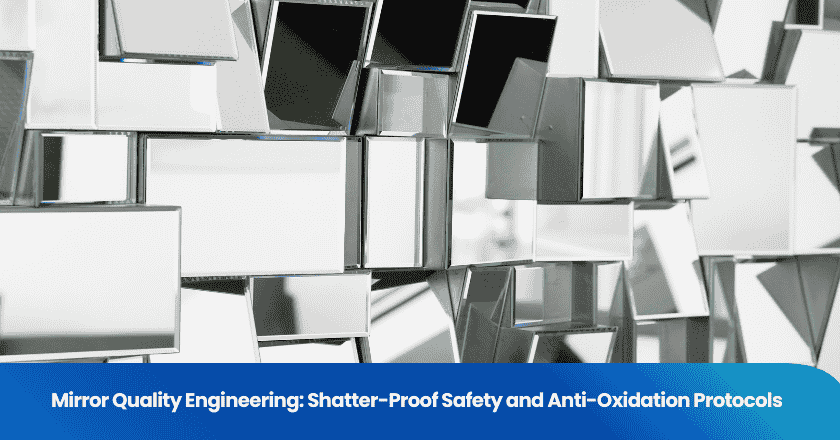
Mirror manufacturing has evolved from simple glass silvering to a complex multi-stage engineering process designed to prioritize user safety and aesthetic longevity. In the global trade of Hardline Products, two technical validations are paramount: the Safety Backing Shatter Test and the Silver Mirror Anti-Oxidation Check. These protocols address the primary failure modes of reflective surfaces—structural shattering and chemical corrosion. By adhering to international standards such as ANSI Z97.1 and ISO 9227, manufacturers can ensure that mirrors not only maintain exceptional clarity but also prevent hazardous injuries in the event of breakage.
The Mechanics of Safety Backing Films
Unlike tempered glass, which shatters into small, blunt cubes, standard annealed mirror glass breaks into large, knife-like shards. To mitigate this risk, safety backing films (often referred to as CAT I or CAT II films) are applied to the reverse side of the mirror. This film acts as a high-tensile adhesive matrix that holds fragments together upon impact. In professional quality control and assurance, the efficacy of this backing is determined through impact resistance testing.
Category I vs. Category II Safety Backing
Safety films are classified based on their thickness and adhesive properties. Category I films are typically used for residential applications, while Category II films—reinforced with woven scrim—are required for high-traffic or commercial environments. The technical goal is to ensure that even if the glass substrate fails, 98% or more of the fragments remain bonded to the film, preventing dangerous "glass fallout."
| Film Category | Reinforcement | Common Thickness | Ideal Application |
|---|---|---|---|
| CAT I | Clear/White PE | 0.07mm - 0.10mm | Wall mirrors, Wardrobe doors |
| CAT II | Woven Scrim Layer | 0.12mm - 0.15mm | Gym mirrors, Dance studios, Public spaces |
The Chemistry of Mirror Oxidation
The "Silvering" of a mirror involves a delicate chemical deposition of silver nitrate onto glass. While silver provides the highest reflectivity, it is highly reactive to environmental pollutants, specifically moisture and sulfur. When these elements penetrate the protective lacquer, they react with the silver to form Silver Sulfide (Ag2S), resulting in the characteristic "black spots" or "edge rot" seen in older or low-quality mirrors.
The Protective Multi-Layer System
To prevent oxidation, a high-quality silver mirror is protected by a multi-layer barrier. After the silver layer is deposited, a layer of copper is typically applied via electrolysis to act as a "sacrificial" barrier. This is followed by two separate coats of protective lead-free lacquer. Modern copper-free mirrors use specialized passivating agents to achieve similar or superior results without the environmental impact of copper.
Technical Insight: "Black Edge" (Edgework corrosion) often begins where the mirror glass has been cut or beveled. If the edges are not properly sealed, moisture travels between the glass and the paint layer, triggering rapid oxidation.
Anti-Oxidation Verification: Salt Spray and CASS Testing
To verify the integrity of the protective backing, mirrors undergo accelerated aging tests. The Neutral Salt Spray (NSS) test, governed by ISO 9227 or ASTM B117, exposes the mirror to a 5% saline mist at 35'C. For automotive or marine-grade mirrors, the Copper-accelerated Acetic Acid Salt Spray (CASS) test is used. CASS is significantly more aggressive, utilizing a lower pH and higher temperature to simulate years of exposure to harsh, corrosive environments in just a few days.
| Test Type | Environment | Technical Objective |
|---|---|---|
| NSS Test | 5% NaCl Mist | Verifies lacquer and copper barrier integrity |
| CASS Test | NaCl + CuCl2 + Acetic Acid | Predicts longevity in humid/salty environments |
| Damp Heat Test | 95%+ Humidity / 40'C | Tests the adhesion stability of the backing |
Industry Standards for Global Compliance
For importers and manufacturers, navigating standardized product inspections is essential for market entry. The ANSI Z97.1 standard (US) and EN 12600 (EU) provide the specific drop heights and impact weights required for safety glazing. In the automotive sector, the FMVSS 111 standard dictates reflectivity and corrosion requirements for side and rearview mirrors.
Ensuring compliance often involves a thorough factory audit to confirm the mirror production line utilizes automatic silvering machines and infrared drying tunnels, which are critical for achieving a uniform, high-adhesion coating that resists oxidation.
Practical Maintenance and Longevity Protocols
Even a mirror that passes the most rigorous mechanical testing can fail prematurely if handled incorrectly. Professional installers and maintenance teams should adhere to the following protocols:
- Avoid Ammonia-Based Cleaners: Ammonia is a powerful oxidant that can dissolve the protective paint and attack the silver layer if it drips behind the mirror.
- Proper Edge Sealing: For mirrors used in bathrooms, applying a neutral-cure silicone sealant to the edges prevents steam from infiltrating the backing.
- Ventilation: Excessive humidity is the primary catalyst for oxidation. Ensuring active airflow in mirror-heavy spaces (like gyms or spas) extends the mirror's life by 30-50%.
When sourcing mirrors, always request a "Pummel Test" report for laminated mirrors or a "Cross-cut Adhesion" report for silver-backed mirrors. These technical documents confirm that the bond between the glass and its protective layers is sufficient to withstand thermal expansion and mechanical shock.
FAQ
What is the difference between a silver mirror and an aluminum mirror?
Silver mirrors use chemical deposition and provide higher reflectivity (approx. 95%) and better depth. Aluminum mirrors use vacuum sputtering and are cheaper but have lower reflectivity (approx. 85%) and are more prone to atmospheric oxidation.
Can an oxidized mirror be repaired?
Unfortunately, once oxidation (black spots) has begun on the silver layer, it cannot be reversed. The only solution is "re-silvering," which involves stripping the old paint and silver and re-applying the chemical layers—a process that is often more expensive than replacing the mirror itself.
Is safety backing required by law?
In many jurisdictions, safety glazing (mirrors with safety backing or laminated mirrors) is mandatory for "hazardous locations," such as doors, low-level wall mirrors, or mirrors in public schools and healthcare facilities.
How long should a high-quality mirror last?
A mirror that has passed professional anti-oxidation and salt spray checks should last between 10 and 20 years in a standard residential environment. In high-humidity coastal areas, this may be reduced if the edges are not specifically sealed.
Why do mirrors develop "clouds" or haze?
This is often a sign of hydrolytic degradation of the paint layer. If the protective lacquer is not moisture-resistant, it can soften and allow water to interact with the metal reflective layer, causing a hazy or cloudy appearance before the onset of actual black spots.
Related Articles

Grow your business with TradeAider Service
Click the button below to directly enter the TradeAider Service System. The simple steps from booking and payment to receiving reports are easy to operate.